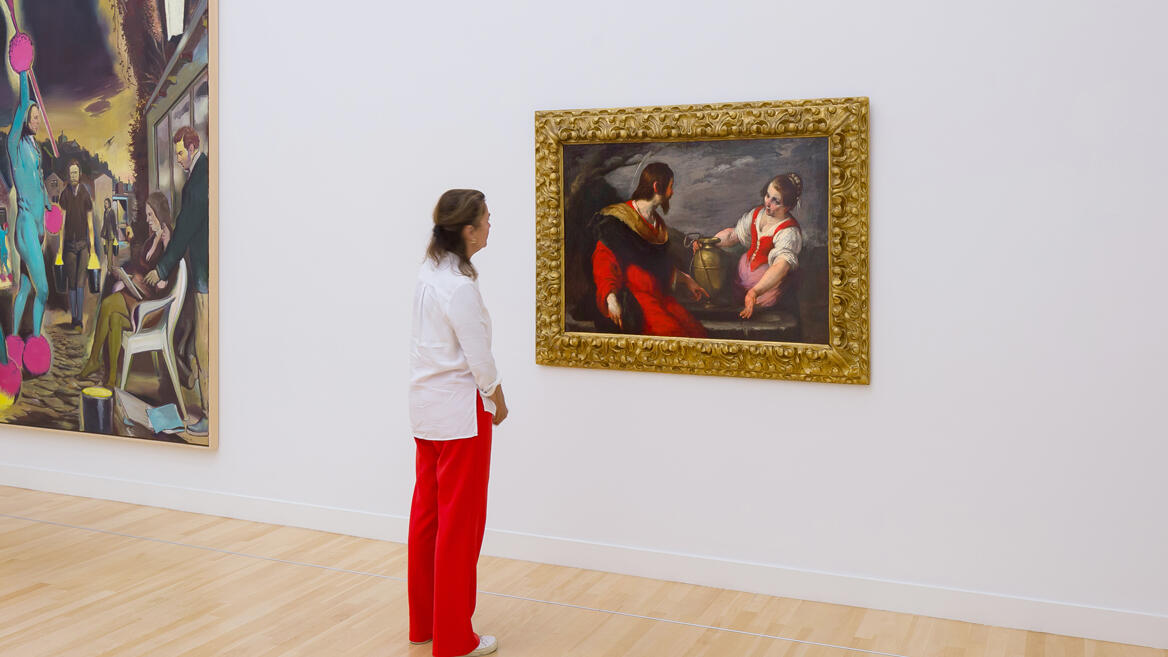
19-04-2021 - In accordance with the Kohnstamm Committee's advisory report Striving for Justice of 7 December 2020 and the 1998 Washington Principles, the heirs of Richard Semmel and Museum de Fundatie have reached agreement on Bernardo Strozzi's painting Christ and the Samaritan Woman at the Well (1635).
The museum will pay the heirs a sum of €200,000 as full compensation for the loss of this painting caused by Nazi persecution. The painting remains part of Museum de Fundatie's collection and the heirs acknowledge the museum's ownership.
Until 1933, Christ and the Samaritan Woman at the Well was owned by wealthy German entrepreneur and art collector Richard Semmel (1875-1950). Semmel lived in Berlin with his wife Clara Cäcilie Brück and owned a large textile factory there. The couple had no children. Semmel's Jewish origin, his leading role within the textile industry and his involvement in the Deutsche Demokratische Partei meant he came under heavy pressure when the Nazis came to power in Germany in 1933. Semmel and his wife fled to the Netherlands that same year and anonymously auctioned off part of their art collection, including Strozzi's painting, at the Amsterdam auction house Frederik Muller & Cie. on 21 November. Dirk Hannema, founder of Museum de Fundatie, bought it there in good faith.
In 1939, the Semmels left the Netherlands and settled in New York. There, Mrs Semmel-Brück died in 1945. Five years later, Richard Semmel died. He had named Grete Gross as sole heir. She died in 1958. The painting has been part of the collection of Museum de Fundatie since 1964.
At the request of Richard Semmel's heirs and Museum de Fundatie, as is customary in the Netherlands, the Advisory Committee on Restitution Applications for Items of Cultural Value and the Second World War (The Restitution Committee) has ruled on this painting. In a binding opinion dated 25 April 2013, the Advisory Committee noted that political and economic circumstances forced Richard Semmel to sell Christ and the Samaritan Woman at the Well in 1933. However, the Restitutions Committee found that the ownership rights of Museum de Fundatie as well as the importance of the painting - one of the highlights within the 17th-century presentation - for the museum collection weighed heavily. As a result, the work could remain in the museum collection, without compensation for the heirs.
In 2020, the Kohnstamm Committee, commissioned by the Minister of Culture and the Council for Culture, launched an evaluation of Dutch restitution policy. In the report Striving for justice, released on 7 December 2020, the committee strongly advised, among other things, that museum interests should not be taken into account in restitution cases.
Museum de Fundatie embraced the Kohnstamm report and, even before the report was adopted by the Culture Minister, contacted Richard Semmel's heirs to discuss with them a just solution for Strozzi's Christ and the Samaritan woman at the well. In line with the advice of the Kohnstamm Commission and the 1998 Washington Principles, the museum and the heirs discussed the various options for compensating for the loss of the painting caused by persecution. The museum offered to return the painting or compensate the heirs financially.
The heirs and the museum, after careful consideration and with mutual respect, jointly decided that De Fundatie would compensate the loss of the painting caused by Nazi persecution by paying the market value of €200,000, -, determined by an independent appraisal, to the heirs of Richard Semmel. Thus, the painting remains in Museum de Fundatie's collection and the heirs now recognise the museum's ownership rights.
The museum will continue to inform the public about Richard Semmel's role in the painting's history. The Fundatie is pleased that this painful matter has been resolved harmoniously with the heirs and is grateful that, thanks to the Semmel heirs, visitors to Museum de Fundatie can continue to view and study the painting by Bernardo Strozzi.