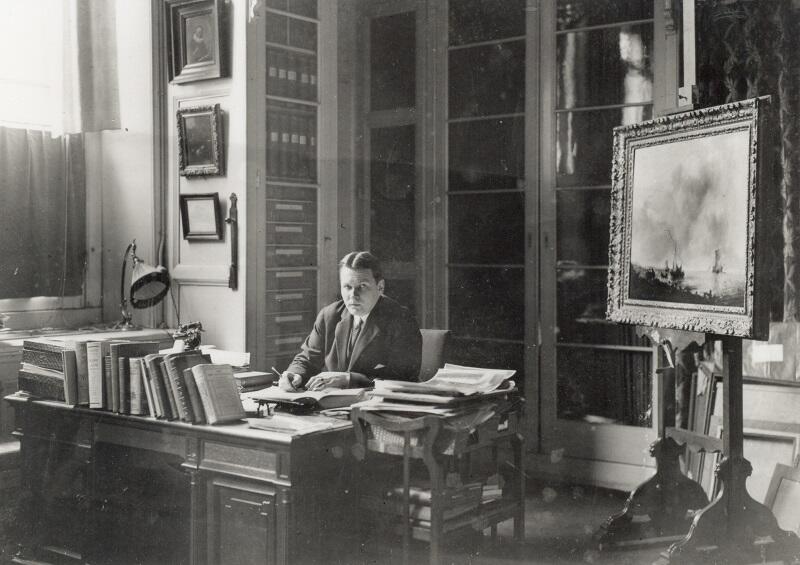
Museum de Fundatie was founded by art lover and collector Dirk Hannema. Who was he, and how did Museum de Fundatie come into being?
A young director
Dirk Hannema became director of Museum Boymans in Rotterdam in 1921. He was only 26 years old at the time. Under his leadership, the museum grew into an important institution, especially after the opening of its new building in 1935.
During the Second World War, Hannema became a controversial figure. He cooperated with the new authorities because he believed this was the best way to protect the museum and Dutch art.
He also acquired the painting The Supper at Emmaus for Museum Boymans, believing it to be a work by Vermeer. After the war, however, the painting turned out to be a forgery by Han van Meegeren. Because of these events, Hannema was unable to return as director of Museum Boymans after the war.
A museum of his own
After that, Hannema devoted himself entirely to his own art collection, which he had been building since his youth. In 1958, he brought his collection to Kasteel het Nijenhuis, where he also went to live. Hannema rented the castle for a symbolic amount. The Province of Overijssel had the castle thoroughly restored, and in 1968 the province purchased it.
Hannema opened his art collection to visitors who requested a guided tour. Even at an advanced age, he continued to guide visitors through the castle and past his artworks himself. In 1964, Hannema donated his collection to the Hannema-de Stuers Fundatie. Dirk Hannema died in 1984.
Hannema's Vermeers
In 1937, Museum Boymans acquired the painting The Supper at Emmaus. Hannema was director of the museum at the time. The painting cost 520,000 guilders, an enormous sum in those days. Hannema and many other art experts believed it was painted by Johannes Vermeer. But in 1945, this proved not to be true. The painting had been made by master forger Han van Meegeren.
Hannema nevertheless continued to believe that The Supper at Emmaus was a genuine Vermeer. He showed little interest in the evidence that it was a forgery. Until his death, he maintained that the painting was authentic. Later, Hannema attributed even more paintings to Vermeer. He believed that Vermeer’s body of work must have been much larger than the roughly forty paintings known today.
The Fundatie Collection includes seven paintings that Hannema firmly believed were works by Vermeer. These are not forgeries like The Supper at Emmaus. They are genuine 17th- and 18th-century paintings, but they were not made by Vermeer. For some of these works, we now know who the real maker was. Others still require further research before their true authorship can be established.
