Curious to know exactly what Miguel Chevalier means by ‘bit’, ‘fractal’ or ‘herbarium’? We’d be happy to explain! Take a look at the glossary for Digital by Nature below.
Algorithms are fundamental to computer science and computer technology. They are a set of rules or instructions consisting of a sequence of simple if–then statements or more complex mathematical equations. Algorithms help collate data, retrieve information, make decisions and recognise patterns. They can also be used to create digital works of art.
The word ‘binary’ comes from the Latin bini, meaning ‘double’ or ‘in pairs’. The binary system uses only two digits, 0 and 1, to represent all numbers. It is the basic language of computing systems and is used to convey data or instructions in an unambiguous and machine-readable form. This ensures high reliability as well as speed for computers and communication systems. Data is stored on a computer as binary code and can then be converted into text or image suitable for display on a screen.
The word ‘bit’ is formed from the words ‘binary’ and ‘digit’. A bit is the smallest binary unit of information and forms the basis for all larger data units in computer technology. In the binary system, a bit consists of either the value 0 or 1.
The word ‘digital’ is derived from the Latin digitus, which means ‘finger’. It refers to counting with one’s fingers. Digital devices use numerical values to display information. This is achieved through an electronic process that generates, stores and processes data in two states: off (0) and on (1). Creating digital artworks always requires hardware such as a computer or a digital camera, as well as the corresponding software.
The word ‘fractal’ is derived from the Latin fractus, meaning ‘broken’, which in turn comes from the verb frangere, meaning ‘to break into pieces’. The term was coined in 1975 by mathematician Benoît Mandelbrot (1924 – 2010). It is used to describe geometric shapes in which similar patterns recur at progressively smaller scales. Fractal patterns can often be found in nature, for example in snowflakes, ferns and Romanesco broccoli, whose individual florets always reflect the vegetable’s overall shape. Abstract fractals can be generated by computers. They often bear the names of their creators, such as the Mandelbrot set, the Sierpinski triangle and the Koch snowflake. Fractals also have a practical application in technology, for example in mobile phone antenna design.
The word ‘generative’ is derived from the Latin generare, which means ‘to generate’. Generative artworks are created by a machine such as a computer using algorithms or mathematical formulas based on a set of rules dictated by an artist. The artist can decide whether to leave all decisions to the machine or to integrate some pre-defined decisions into the set of rules. In either case, they consciously relinquish some control in the creative process. The result is not fully predictable, as endless variations of the initial idea are possible.
An herbarium (from the Latin herba, meaning ‘herb’) is a systematically organised collection of pressed and dried plants and plant parts. The herbarium specimens are usually mounted onto sheets of paper and stored in folders. Other materials such as loose seeds, pollen, dried fruits, algae and fungi are also preserved. They serve as the basis for data sets, botanical illustrations, photographic images and other forms of information for further research.
The word ‘hexadecimal’ is made up of the Greek word ‘hexa’ (six) and the Latin word ‘decem’ (ten). The hexadecimal system is a numbering system. Unlike the decimal system that we use for everyday calculations, the hexadecimal system uses the numbers 0 to 9, but replaces 10 to 15 with A to F. In contrast to the binary system, which uses only the digits 0 and 1 to symbolise numbers, here there are sixteen symbols to represent numbers. For example, if a piece of information has eight digits in the binary system, the same information can be represented with two digits in the hexadecimal system. Large numbers can therefore be represented with fewer digits when using this system, making them faster to write and easier to read in computer science.
Artificial intelligence (AI) is a machine’s ability to simulate human skills such as learning, planning, logical thinking and creative processes. AI uses data to learn how to read information and solve problems. If an AI model is trained with one-sided data, this has an impact on its performance or results. AI-based systems can either be installed in physical devices such as robots, drones or autonomous cars or operate in a purely software-based form in virtual space, for example in search engines, facial or speech recognition systems and image analysis software.
Machine learning is part of the broader concept of artificial intelligence. In machine learning, an algorithm is fed with data. The more data it is given, the more precise its decisions can be. The computer trains and improves itself as the amount of data increases, instead of having to be programmed explicitly for a specific task. However, there is an essential difference between machine learning and AI: while artificial intelligence can deal with unforeseen events (unstructured data), machine learning can only process predictable events (structured data) in a targeted manner. An example from everyday life is that an algorithm detects when money is withdrawn from an account at an unusual location, potentially enabling it to uncover fraud, which becomes possible through the training of machine learning.
The word ‘pixel’ is a contraction of ‘picture’ (pic) and ‘element’ (el). It is the smallest unit of a digital image and contains the three primary colours: red, green and blue (RGB). These have different intensities, allowing different colours to be generated. If, for example, the dimensions of a digital image are given as 3266 × 2449, this is the number of pixels, width by height.
A prompt is an instruction given to artificial intelligence. The prompt can be provided in the form of text, image, audio or other data formats. The AI analyses the input and generates a response based on what it has learned during previous training. It can then produce a specific text, create an image or perform a specific task. Generally, result quality depends on how precisely the prompt is formulated.
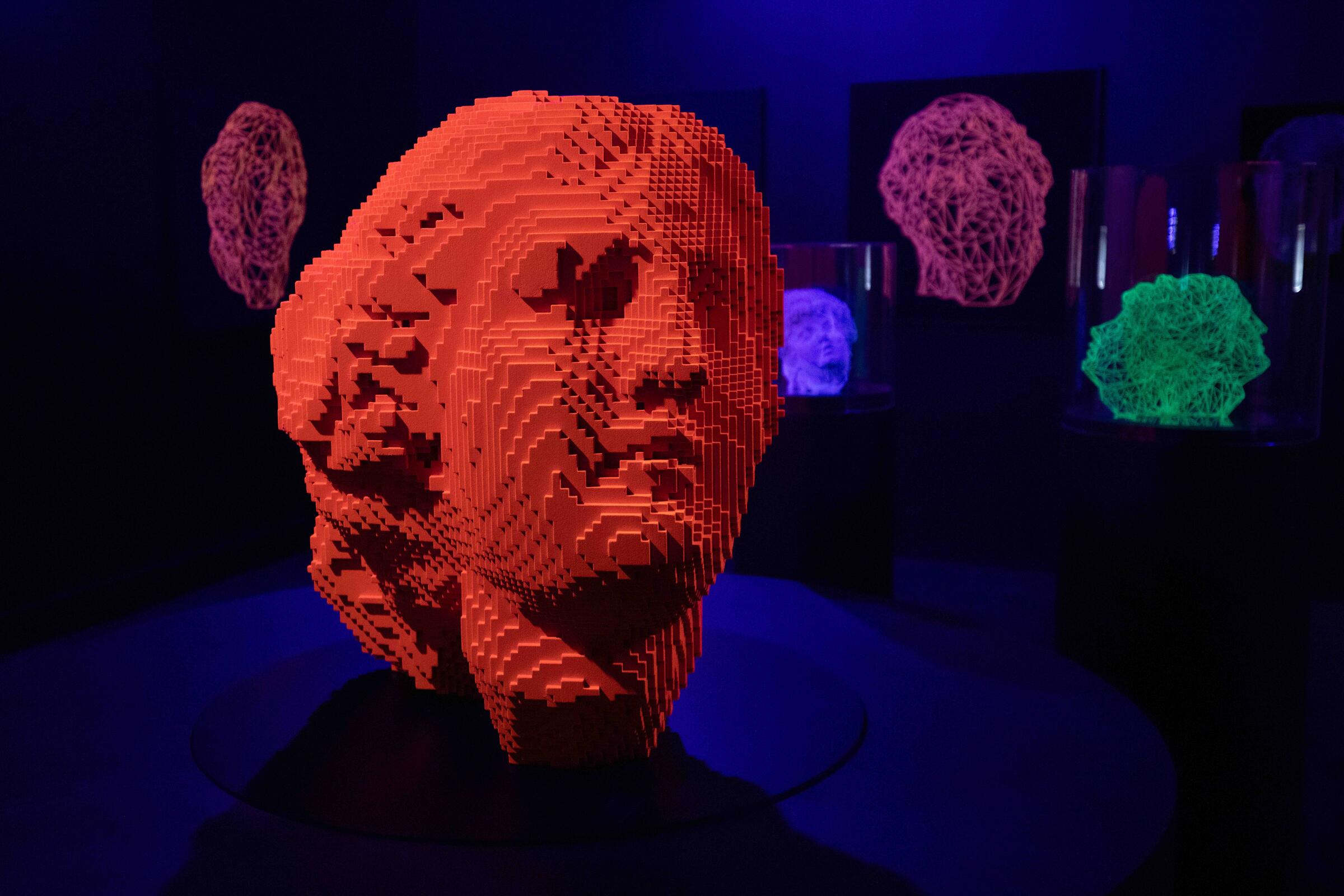
The word ‘voxel’ is a contraction of ‘volume’ and ‘element’ with the addition of x for ease of pronunciation. A voxel can be thought of as a cube. It is the smallest addressable element in a three-dimensional digital representation.