In the heart of Zwolle’s historic city centre, Museum de Fundatie stands on the Blijmarkt. The building is not only a place where art is shown; it is also a striking part of the city in its own right. Discover more about the history of this remarkable building.
From courthouse to museum
The building of Museum de Fundatie in Zwolle brings together almost two centuries of architectural history with a contemporary view of art, architecture and the public. On the one hand, the museum is firmly rooted in Zwolle’s past. On the other, with the striking Cloud on its roof, it has become a contemporary icon of the city.
The oldest part of the building was constructed between 1838 and 1841. It was not a museum then, but a Palace of Justice: a courthouse where legal cases were heard. The building was designed by the Hague-based architect Eduard Louis de Coninck. You can still clearly see that the building was once an important public building. It has a calm, stately presence. The façade is symmetrical and classical. The building also stands in a special place in Zwolle: between the old city centre and the canals that surround it.
Later, the building was used for other purposes, including by the National Spatial Planning Agency. In 2004 and 2005, it was converted into a museum, following a design by architect Gunnar Daan. In this way, the former Palace of Justice was given a new purpose: it became a place for art, encounter and inspiration.

The Cloud
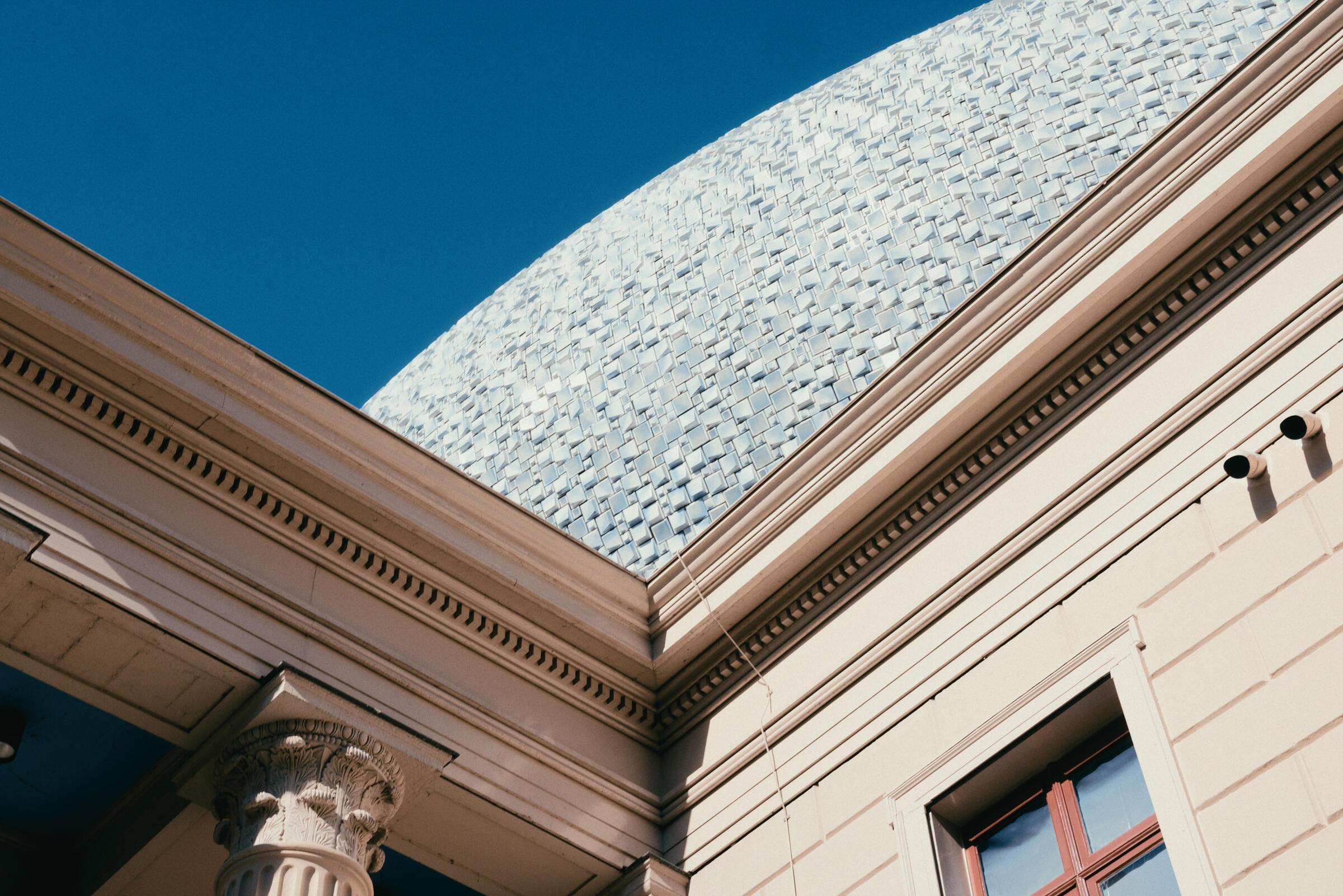
In 2012 and 2013, the building changed once again. The museum was extended with the striking structure on the roof, often referred to as the Cloud. The Cloud was designed by Hubert-Jan Henket of Bierman Henket Architecten. The Cloud immediately catches the eye. The old building is straight, classical and formal. The Cloud, by contrast, is rounded, soft and modern. This creates an exciting contrast between old and new.
On the outside, the Cloud is covered with 55,000 white and blue ceramic tiles, made by Royal Tichelaar Makkum. Depending on the light and the weather, the Cloud always looks slightly different. Sometimes it appears blue, sometimes white or silvery. This makes the structure seem almost to float above the museum.
What makes it even more special is that residents and visitors were able to contribute to the Cloud. For 10 euros, people could buy a tile for the roof covering. On the back of the tile, they could write a personal message. Once the tiles had been placed, the messages were no longer visible, but they were shared on the museum’s Facebook page. In this way, the Cloud was given not only a ceramic exterior, but also a hidden layer of personal stories, names and wishes.

Inside the Cloud
A large oval window offers a view over Zwolle’s historic city centre. In this way, the new part of the museum quite literally looks out over the city from which the building emerged. Inside, too, the extension creates a special experience.
The Cloud contains two exhibition spaces with an unconventional, flowing shape. These spaces contrast strongly with the classical rooms of the original museum building. Precisely because of this, Museum de Fundatie in Zwolle can present many different kinds of art: from historical works in more traditional rooms to contemporary installations and presentations that call for space, openness and a different way of looking.

The Fat Golden Dove
The Cloud is also popularly known as the Egg, because of the rounded, elliptical structure on the roof. On that roof stands another striking artwork: The Fat Golden Peace Dove by artist Marte Röling. The sculpture is made of gold leaf on polyester and is part of the Museum de Fundatie collection. The dove is over two metres high and almost three metres wide. This makes it clearly visible and, together with the Cloud, a recognisable feature of the city.
The golden dove adds something playful to the building. On top of the stately old courthouse and the modern Cloud sits a humorous, gleaming artwork. In this way, the Museum de Fundatie building brings together old and new, dignity and playfulness. Through the personal messages on the tiles, the building also tells a story about people’s connection with the museum. The building of Museum de Fundatie tells several stories at once. Which story speaks to you most?
Photography: Edwin van der Sande