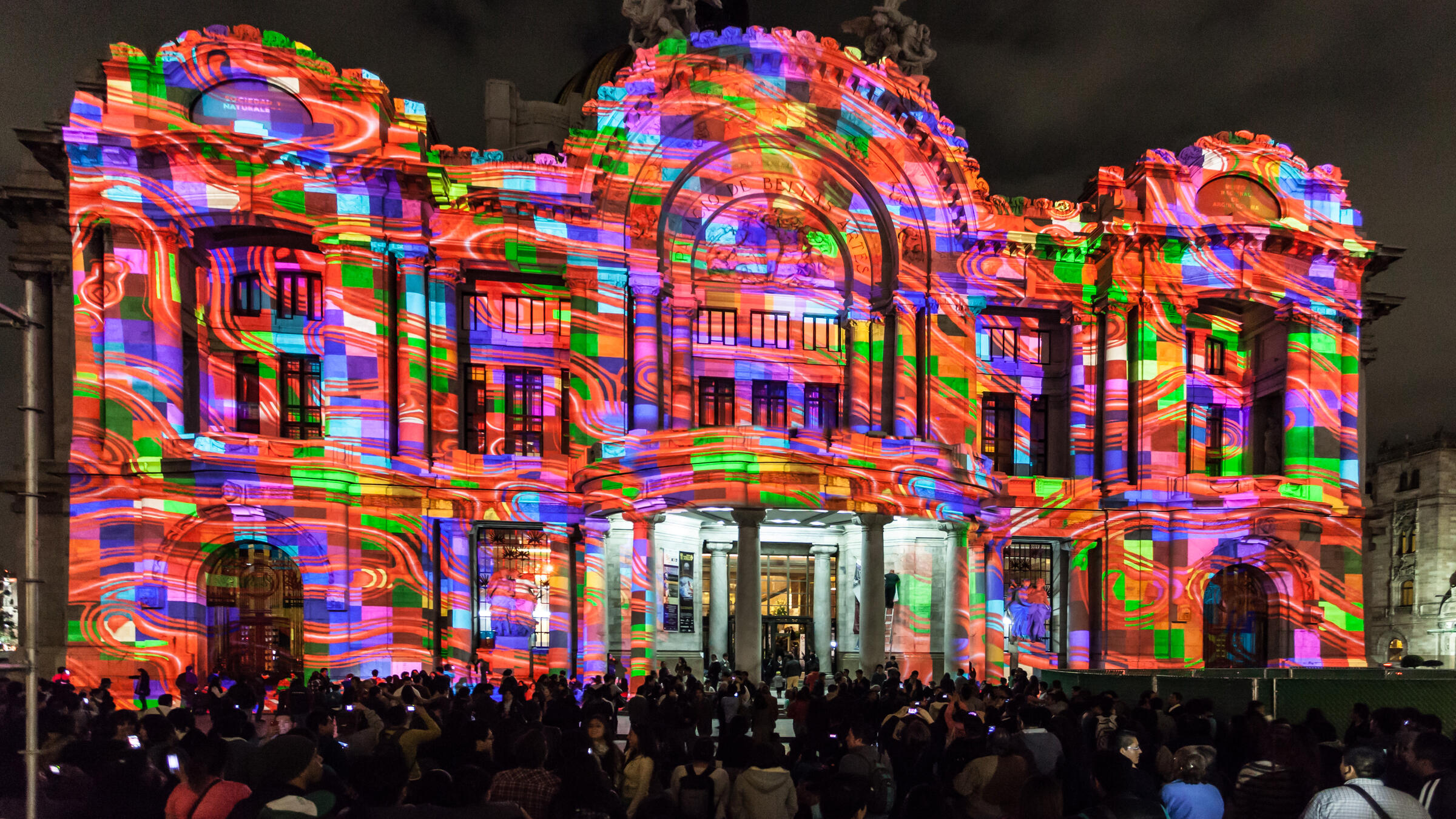
From 10 to 14 December, the neoclassical façade of Museum de Fundatie will be completely transformed. Through dynamic projections by artist Miguel Chevalier, the Museum de Fundatie building in Zwolle will come to life. The building’s sleek columns and classical forms provide the canvas for a moving visual language, transforming the façade into a living surface that is constantly changing and resonates with a succession of symbolic, digital compositions.


The work consists of a series of graphic motifs symbolising the digital world and compositions built up from fundamental geometric shapes. These simple, universal elements form the basic vocabulary of our contemporary digital reality.
The various sequences will change every minute. In this way, they create vast visual waves that wash over the entire façade, undulating, constantly rearranging and transforming. These graphic currents and counter-currents form compositions in which order and chaos, structure and fluidity converge.
Through this intervention, ‘Pixel Waves’ offers a contemporary reinterpretation of neoclassical architecture, by shifting it into an immaterial and sensory dimension. The work draws on the principle of trompe-l’œil*, whilst at the same time subtly challenging the viewer’s perception. The project places the building within a new temporality – a temporality of change and transformation – and invites the public to an immersive experience in which heritage and the visual language of the 21st century converge.
The event-based project I am proposing for the façade of Museum de Fundatie is entitled “Pixel Waves”. It is conceived as a complement to the exhibition inside the museum: it extends the exhibition’s content into the public space whilst simultaneously entering into a direct dialogue with the building’s architecture.
*trompe-l’œil: French for ‘to deceive the eye’, is an artistic technique that uses realistic imagery to create the optical illusion that painted or depicted objects exist in three-dimensional space
