"My father and mother are German, both of mixed European descent. When I was three, we emigrated to the Netherlands after my father was appointed professor of German literature at the University of Amsterdam. We lived in Laren. Looking back, I would have preferred to grow up in Amsterdam at the time. My parents used to go to all the fun, wild artists’ parties there. They did, however, drag me along to museums from a very young age, such as the Stedelijk. The first exhibition I consciously remember was by Jean Tinguely, in 1973. It was brilliant: you could press all these red buttons and then something would start moving!”
exciting trends
“After school, I decided to spend a gap year studying painting at an art college in London, but in the end I went to Freiburg im Breisgau to study art history. I was curious about my parents’ homeland, although they weren’t exactly enthusiastic about my choice of degree. I then studied in Paris and Cologne. In the late 1980s, Cologne had a thriving art, photography and music scene; I stayed there for a while. During my studies, I discovered modernism, particularly that of the 1920s: Dada, surrealism, cubism and expressionism. It struck me as an exciting time, with all those movements influencing and clashing with one another. It was revolutionary: devising and launching something completely new. It all began around 1900 in Vienna: the Secession, with Gustav Klimt and artists influenced by it, such as Oskar Kokoschka. At the same time, Cubism and Expressionism emerged. Many disciplines intertwined. Artists attended dance performances, listened to music and experimented with film. It’s almost as if all the art of today was invented back then.”
more women
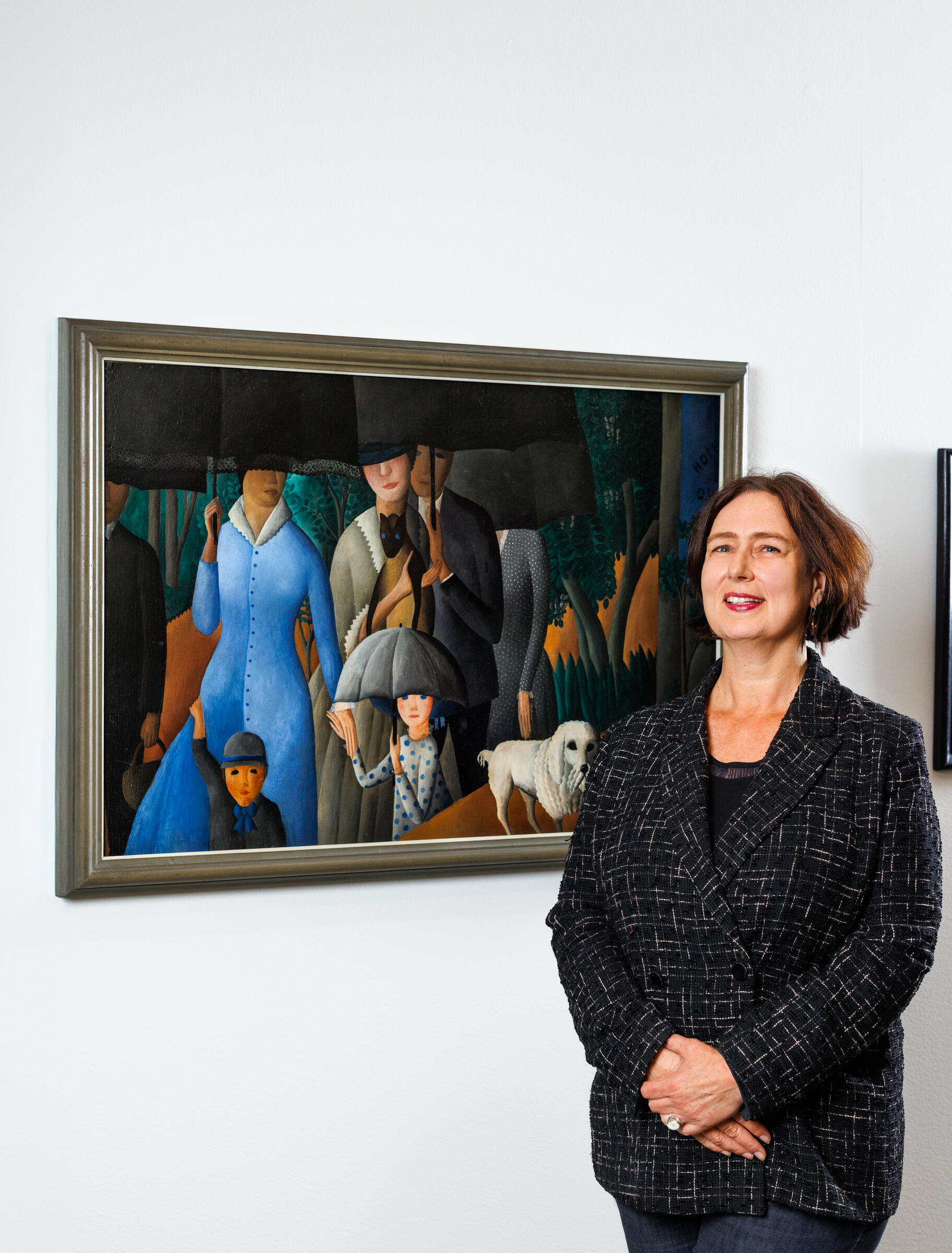
"De Fundatie comprises two sites, one in the centre of Zwolle and one in Heino. Each building has its own character and audience. The collection, comprising works from our own holdings and those of the province of Overijssel, spans from prehistory and the late Middle Ages to the present day. This means there are endless possibilities. A common thread is figurative art, and we do have a number of expressionist paintings. We do not have the resources to build up a retrospective collection of experimental, abstract, Cubist or Constructivist art, but we do seek out contemporary works that align with those movements. Our identity might perhaps be described as polyphonic: we aim to be as broad and versatile as possible. Like many collections in the Netherlands, De Fundatie has very few works by female artists, and although we can’t make up for that now, we are trying to give it more attention. With that in mind, I’ve chosen *Promenade* by Olga Sacharova, a painting from 1923. I think it’s wonderful. Olga was from Georgia, but travelled extensively, including to Rome and Munich, where she came into contact with the Expressionists. She moved to Paris around 1912 with her British husband Otto Lloyd, also an artist, and during the First World War to Barcelona, where she collaborated with Dadaists, including Francis Picabia. She moved in the same circles as Marie Vassilieff and Aleksandra Ekster, key figures in the Russian and Ukrainian avant-garde in Paris.”
with a touch of humour
“Promenade is an intriguing painting: figurative yet experimental in form and colour, and subtly abstracted in a delightful way. It reminds me of the work of August Macke and Amedeo Modigliani. You can imagine all sorts of stories to go with it. That woman in the grey dress, right at the back – is she the governess or the mistress? It was the era of the flâneurs and Sunday strolls. Dressed to the nines, to see and be seen. Here is a family out for a stroll, complete with entourage, poodle and blue-eyed Siamese cat. The painting has a dreamlike and surreal quality, but it’s also ironic. I sometimes find humour lacking in contemporary art. In *Promenade* I detect a touch of humour: that Sunday stroll in your Sunday best is a bourgeois cliché, but suddenly you notice that one of the women is carrying a cat. The proportions aren’t quite right: the dog is at a different level to the people. The adults’ eyes are veiled beneath their umbrellas or parasols, whilst the children have an almost lifeless expression in their eyes. To see and be seen? By covering her figures’ eyes – so that you actually cannot see them – Sacharova turns it into a subtle game of irony.”

Beatrice von Bormann
Born 1968, Berlin
Education art history; French and English literature in Freiburg (1988–90), Paris (1990–91) and Cologne (1991–96)
Career including Head of Collections and Chief Curator at the Museum der Moderne Salzburg; Curator of Modern Art at the Stedelijk Museum Amsterdam (2017–2022); Director of Museum De Fundatie since January 2023.
Exhibitions At Home with Ter Borch, Ivna Esajas – In The Garden of My Good Days.
Lives in Zwolle with her dogs since 2023